







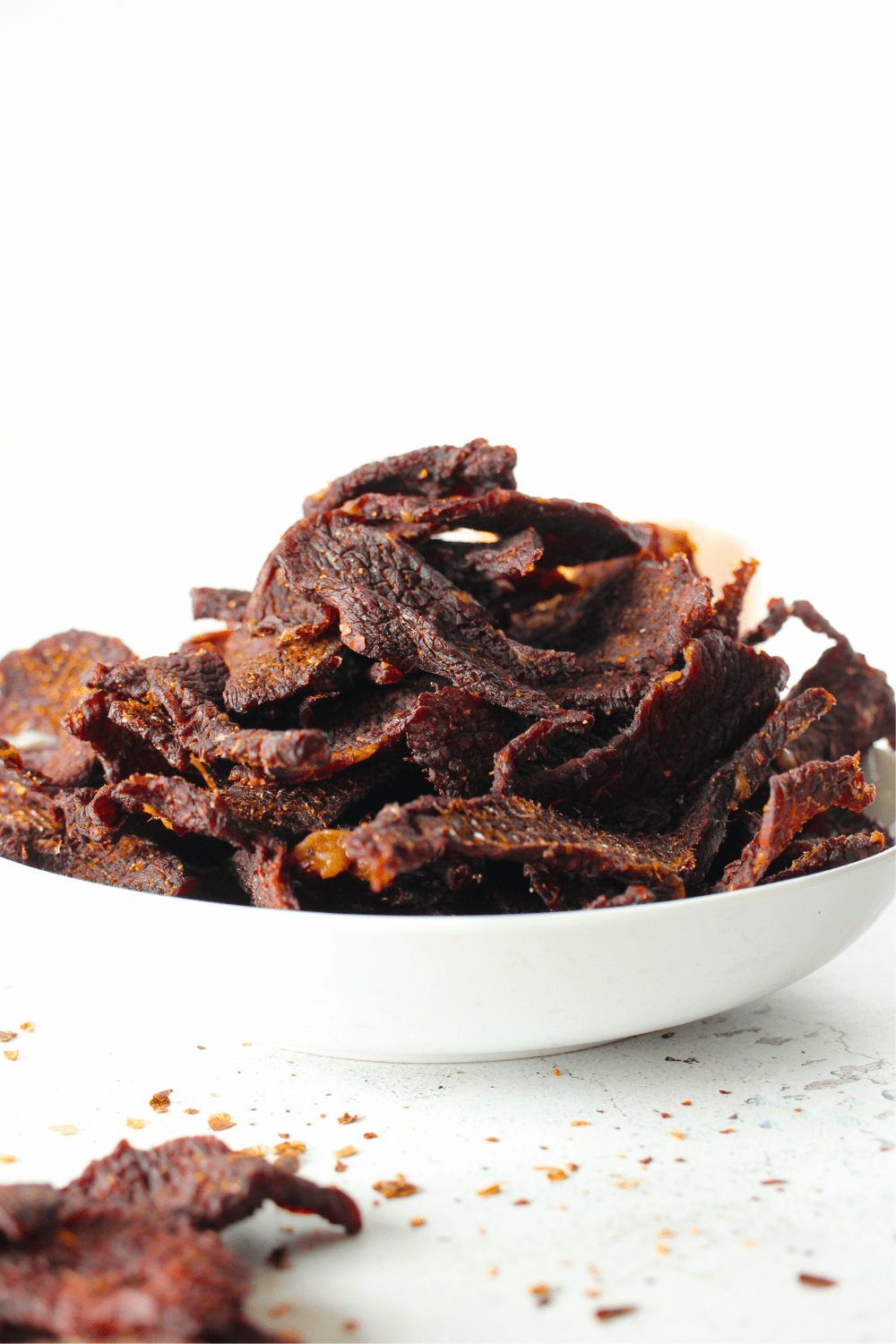
How to Make Homemade Jerky using either an Air Fryer, Oven or Dehydrator - Whichever way you make keto jerky, you will be pleasantly surprised at how effortless making carnivore jerky at home can be. With only a handful of ingredients and some time patiently waiting for the meat to dry out, making keto jerky is super easy.

Keto Jerky
I love jerky!
It is by far my favourite snack.
And making jerky is not only easy but the combination of flavours is unlimited!
Wasabi Ginger Soy, Smoked BBQ, Chipotle or hot "honey" jerky...any level of sweetness or spiciness can be made with just a few simple ingredients. I have included an oven jerky recipe, an air fryer jerky recipe as well as a dehydrator jerky recipe - whichever way you make it, I am sure it will soon become your favourite snack!
Why do I love Homemade Jerky so much?
- it is healthy and nutritious and packed full of iron (which MANY women are deficient in)
- it does not need to be refrigerated so it is perfect for your kids' lunch box, hiking or a grab-and-go snack
- it is significantly cheaper than buying store-bought jerky
- you can control the ingredients (many store brands contain a TON of additives)
- it only takes a couple of minutes to prepare
- you can make it in the oven, an air fryer or in a dehydrator
- it lasts for over 1 month (if you don't eat it all before!)
- it is the perfect low-carb and keto-friendly as well as carnivore snack!
What exactly is jerky and where did the name come from?
- Jerky is a nutrient-dense, convenient and shelf-stable meat product
- Derived from the Spanish word “charqui,” which describes dried meat strips
- Jerky may be produced using a combination of curing, smoking and drying procedures
- Traditionally jerky was made by the use of sun, wind, and smoke from fires
- American Indians dried thin strips of game meats under the sun to make a product called “boppa,” which was preserved without salt or smoke. “Pemmican” was a mixture of berries or suet with pounded dried meat.
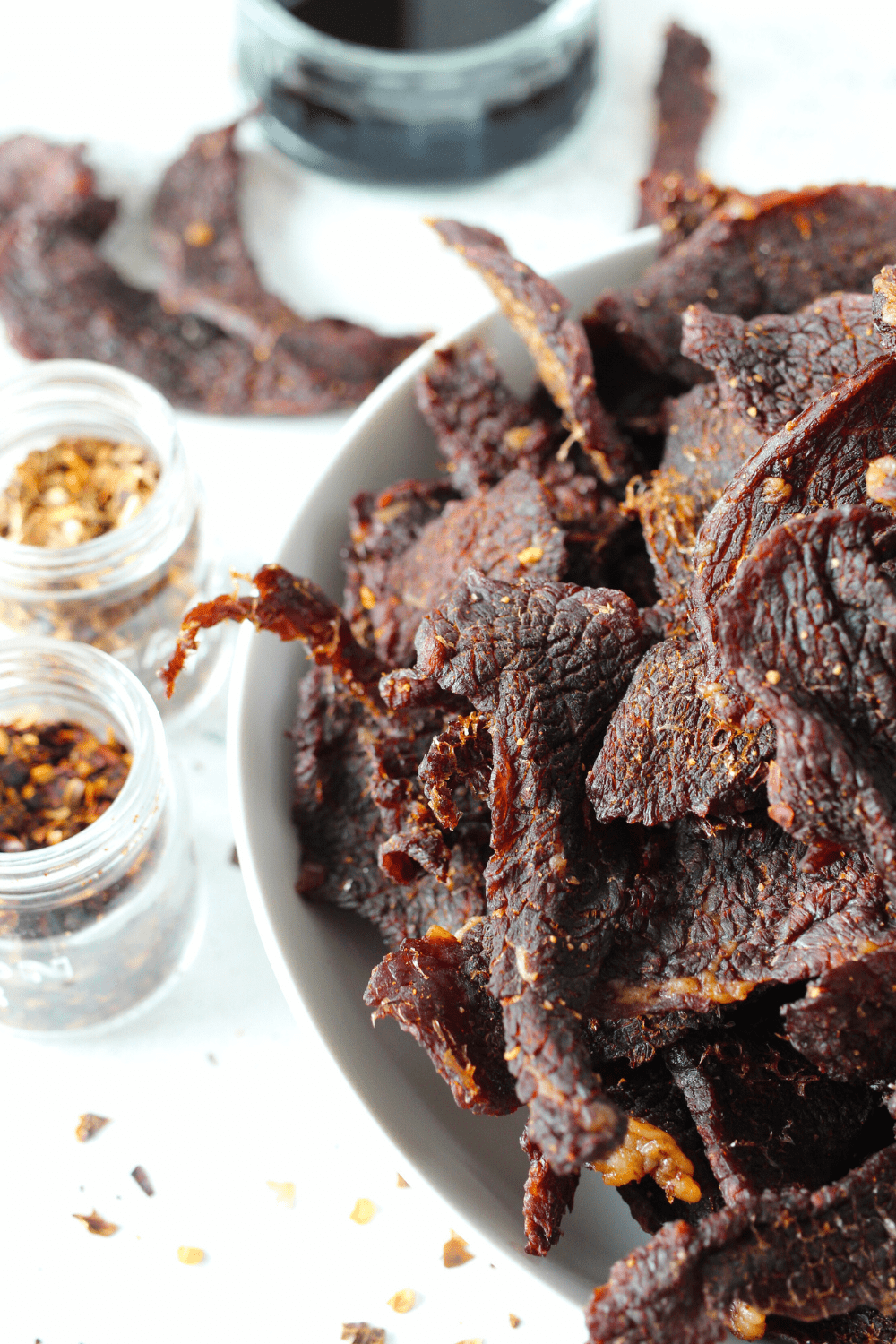
What type of meat is best to use when making Homemade Jerky?
Essentially, any meat source can be used to make jerky, but typically, lean cuts such as beef round roasts or pork loin are used. Lean cuts are more desirable because fat can become rancid during storage, resulting in off-flavours.
You can also use any type of ground meat as long as you make sure that your jerky is cooked to 160 degrees F. Using ground meat means that there is more surface area for bacteria to hide. To ensure that your meat is fully cooked, you can precook your meat to 160 degrees and dehydrate it to create jerky.
What are the top choices of beef cuts for making homemade jerky?
Since we don't want to use the most expensive meat on the market (although I will tell you that filet mignon does make a mean jerky!), here are the top 3 economical choices for jerky:
- Round - The most common beef jerky cuts are round, taken from the rump of the cow, due to the sheer size of the muscle.
- Flank - The flank steak, a section of meat taken from the stomach, is not as soft as the round.
- Sirloin - Perhaps the most popular cut of beef is the sirloin tip, a section of meat from a cow's lower back.
I typically get top or bottom round from Costco or Sam's Club for under $3 a pound.
How to Store Homemade Keto Jerky
Here are a variety of different ways that you should store jerky. Each method depends on the thickness of the jerky, along with the amount of fat on the jerky.
For lean jerky with very little fat:
- store the jerky at room temperature, in an airtight container. I actually take the silica gel pack from a bottle of supplements and stick it in with the jerky just to be safe.
- If stored properly, jerky stored on the counter can last up to 6 months.
For thicker slices of jerky:
- I recommend storing the jerky in the fridge by placing the jerky in an airtight container.
- Make sure your container is properly sealed as the moisture in the fridge can affect the jerky.
- Jerky in the fridge can last (although I have never tried it!) up to 6 months
For fattier pieces of jerky:
- Fattier slices of jerky can turn rancid and should not be stored at room temperature
- Fattier jerky should be stored in the freezer
- First, wrap the fattier jerky in a paper towel to absorb any excess oil.
- Let it rest for a couple of hours and then remove the jerky place it in a Ziplock Freezer bag and write the date/flavour on the bag.
How to Make Homemade Jerky
There are 3 basic ways in which you can make homemade jerky. Whether you choose the oven jerky recipe, the air fryer jerky recipe or the dehydrator jerky recipe, they will all turn out amazing. Here are the pros and cons of each:
In an Electric Dehydrators:
- the easiest way to dehydrate meat
- make sure that the air can flow from the top and bottom
- you may need to turn trays at the halfway point
- use mesh sheets that contain holes to allow the flow of air
- my favourite electric dehydrator is the Excalibur
- bake the jerky at 165 degrees for anywhere from 4-8 hours
- CON - a good dehydrator can run about $250
In an Oven:
- can take a little longer due to the lack of airflow (you can prop your oven door open using a wooden spoon to encourage airflow or place your oven on "convection" if you have this feature)
- place jerky on a wire rack that has been sprayed with cooking spray - place the rack in a rimmed baking sheet
- turn the oven to 150-165 degrees - you may need to turn the oven on and off every couple of hours if you can not maintain this temperature range
- drying can take 4-24 hours depending on the thickness of the jerky
- CONS - running the oven can heat up your house, temperature is hard to control
In a Air Fryer:
- very easy to use
- you will need to buy a dehydrator rack (I got this one from Amazon and I love it!)
- spray the rack with cooking spray
- set it on "dehydrate" for 4-6 hours (depending on the thickness of the jerky)
- CON - you can only make a small amount of jerky at one time
Basic Ingredients for Making Keto Jerky
All jerky recipes require 5 basic components:
- a meat
- some salt
- an acid
- a sweetener
- different flavourings
Best ingredients for Carnivore Jerky
MEAT:
- choose a lean cut of meat
- trim the meat to remove any excess fat
- place the meat in the freezer and allow it to partially thaw to make it easier to slice thinly
- the thinner the slices the less time you need to dehydrate the meat
SALT:
- Use the purest salt you can find
- The rule of thumb is for every 1 lb of meat, you need about 1 teaspoon of salt
- Soy sauce and Teriyaki sauce are the most commonly used "liquid" salts
ACID:
- Vinegar such as apple cider works very well (use no more than ¼ cup of vinegar for 1 lb of meat)
- Wine, Sherry or beer can also be used to help tenderize the meat
SWEETENER:
- To keep this a sugar-free jerky, I use a brown sugar substitute, such as Truvia. If you want to keep this recipe carnivore-friendly, omit the sweetener or use honey.
FLAVOURINGS:
- Liquid smoke is often used but does not use more than ¼-1/2 teaspoon for every 1 lb of meat
- Fresh herbs or dried herbs can be used
- The general rule of thumb is for every 1 lb of meat, you will use 1-2 tablespoon of fresh herbs or 1-2 teaspoon of dried herbs
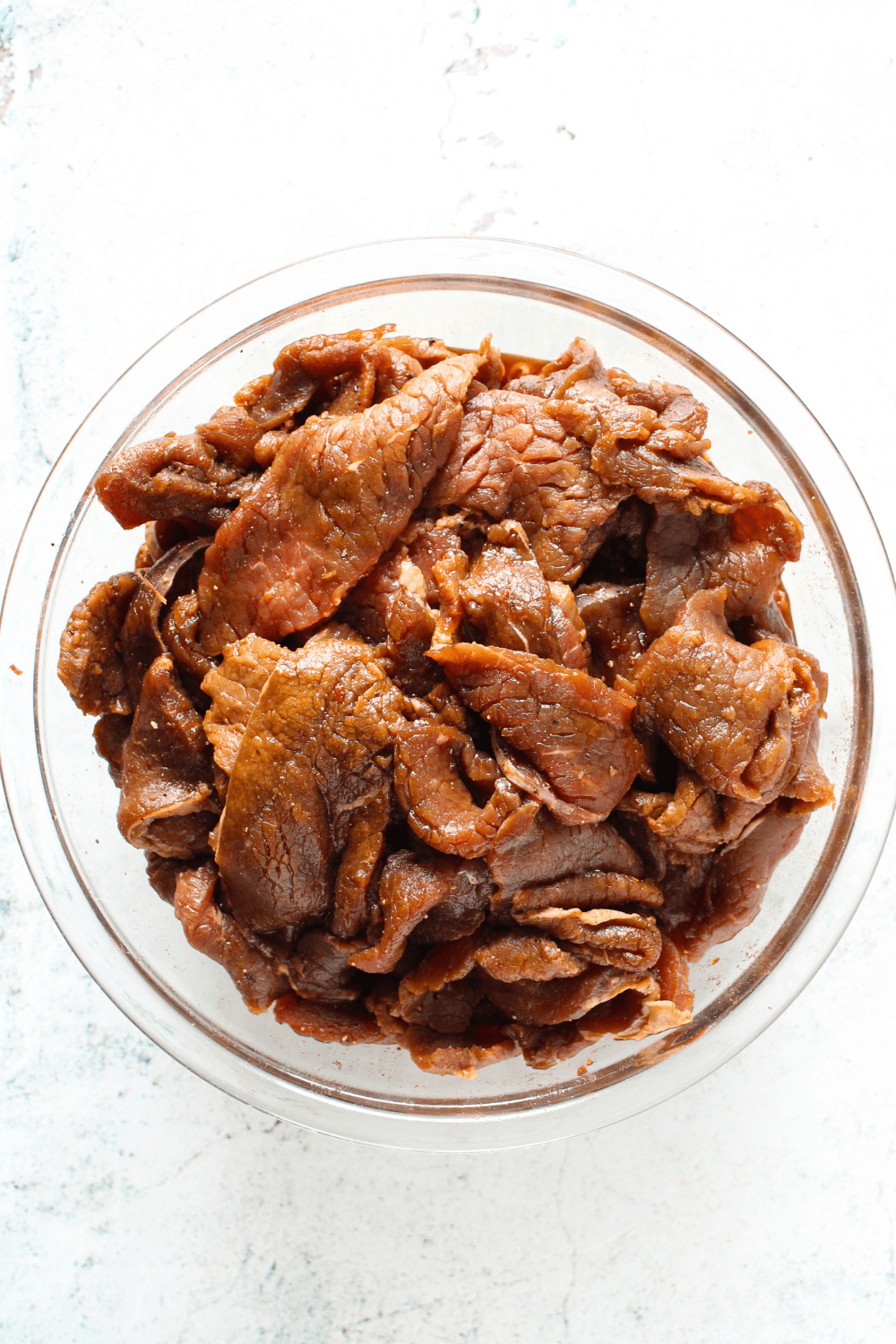
Why should you pretreat the meat before making homemade jerky?
Whether you make an oven jerky recipe or an air fryer jerky recipe, you should always marinate the meat first. Here are some reasons why:
- pretreating the meat with a marinade adds a ton of flavour
- brine is used which is simply a thin marinade with a high concentration of salt
- you can also use a paste instead of a marinade
- the general rule of thumb is to allow all the marinade ingredients to rest for 15 minutes before adding the meat
- you need about 1 cup of liquid for every 1 lb of meat
- if marinating for more than 1 hour, place the ingredients in the fridge and stir every 8-12 hours (you can leave the meat marinating for several days in the fridge
How long does homemade jerky last?
The shelf life of jerky is dependent on 3 main components: 1 - Moisture content - if dried properly, the moisture content of jerky should be quite low
2 - Packaging - the more airtight the container, the longer the shelf life.
3 - Temperatures - cool and dry will extend the life of jerky. If all 3 of these conditions are met, then the average homemade jerky can last up to 6 months.
What is the ideal temperature for making jerky?
All raw meats must be dried at a temperature of 145 degrees and above. The internal temperature of the meat must remain at this temperature for at least 10 minutes.
How should you slice the meat for the jerky?
Here are some basic pointers when slicing the meat for jerky: cut the meat across the grain to make the jerky easier to chew, slice the meat into ⅛-1/4 inch slices
and make each slice no more than 5-6 inches in length and lastly, use semi-frozen meat to make slicing the meat nice and thin much easier.

Tips and tricks for making Keto Jerky:
- always place meat in a single layer
- make sure the meat is lying flat
- make sure meat does not overlap
- rotate trays top to bottom and as well as turn the trays every few hours
- when marinating meat, use glass, porcelain, or stainless steel - do not use aluminum
- use no more than ¼ cup of vinegar for 1 lb of meat
More Keto Air Fryer Recipes
Looking for other keto air fryer recipes like this? Try these:


These are my favourite keto carnivore recipes:




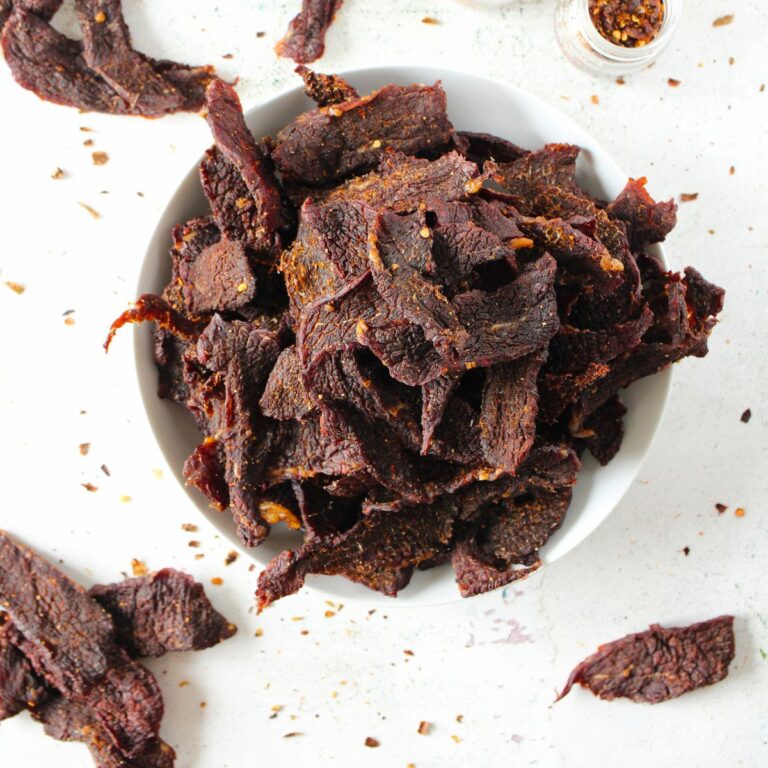
The Best Keto Jerky Recipe
How to Make Homemade Jerky in the oven, dehydrator or in a Ninja Foodi could not be any easier. Save a TON of money and make a delicious and healthy treat. Perfect for a snack or as part of your kid's lunch box, homemade jerky is much healthier and cheaper than anything you can buy at the store. Gluten-free, keto, Paleo and Whole30, try this recipe today and you will never buy jerky again!
- Total Time: 0 hours
- Yield: 18 oz 1x
Ingredients
- 1 - 3lb eye of round or bottom round roast, trimmed of excess fat
- 1 cup soy sauce
- ½ cup brown sugar substitute (such as Lakanto or Truvia)
- 3 tbsp Worcestershire sauce
- 1 tbsp smoked paprika
- 1 tsp liquid smoke
- 1 tsp red pepper flakes
- 1 tsp onion powder
- 1 tsp ground pepper
- OPTIONAL - 1-3 teaspoon chili powder (for added heat if you want!)
- 1 lb meat, cut into strips
Instructions
- Slice the meat between ⅛-1/4 inch thickness, across the grain.
- In a large bowl, whisk together all the ingredients (except for the meat) until the sweetener has dissolved.
- Add the meat strips to the bowl and toss until all pieces and sides of the meat have been coated in the marinade. Marinate for at least 12 hours or up to 2 days.
- Remove the beef from the marinade and place beef strips on the dehydrator rack, baking rack set in a lined-rimmed baking sheet, or on racks made for an air fryer.
- Dehydrate depending on the method (see post for details)
- Allow the jerky to fully cool before placing the jerky in an airtight container.
Notes
- always place meat in a single layer
- make sure meat is lying flat
- make sure meat does not overlap
- rotate trays top to bottom and as well as turn the trays every few hours
- when marinating meat, use glass, porcelain or stainless steel - do not use aluminum
- use no more than ¼ cup of vinegar for 1 lb of meat
- Prep Time: 5 minutes
- 12 hours: marinating
- Cook Time: 3-6 hours
- Category: Homemade, Snacks
- Method: Dehyrdating
- Cuisine: American
- Diet: Gluten Free
Nutrition
- Serving Size: 1 oz
- Calories: 60
- Sugar: 0.5
- Fat: 4
- Carbohydrates: 1
- Fiber: 0
- Protein: 6



Leave a Reply