


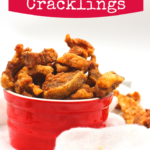
These air fryer pork cracklings are so easy to make and delicious to eat. Don't waste the fat cap off your next pulled pork meal. Simply slice it, add some spices and throw it in your air fryer and 30 minutes later, you have Whole30, Paleo and Keto approved pork cracklings!
Most of you know that decreasing my carbon footprint is a goal of mine.
Since Mr. Grumbles and I both enjoy pulled pork, I end up with quite a bit of the fat cap of the pork leftover.
5-Spice Ginger Pulled Pork, Simple Pork Fried Rice, Crispy Slow Cooker Pulled Pork as well as my Healthy and Easy Cuban Casserole are only a few of my favourite recipes that I have made to date.

Since buying pasture-raised pork is not cheap, I hate to throw any part of it away. Not knowing what to do with a recent leftover pork fat cap, I decided to place it in a container and freeze it. I knew I could find some sort of recipe that I could recycle this lovely piece of fat.
After doing some research on the internet, I found a wonderful article by Kimberly. Her website, "The Daring Gourmet", is filled with very interesting recipes. Her philosophy is similar to mine:
- Eat real, whole foods as close to their natural state as possible
- Eat things in moderation.
Kimberly wrote an entire post as to the cause of the disappearance of lard from our shelves which I found fascinating.

Here is a small excerpt of her post taking directly from Kimberly's website:
In the early 1900s, Proctor and Gamble had a booming business producing cotton. Which, by the way, is not considered a food crop by the FDA. (That’s important. Keep reading.) But there was this unwanted portion of the cotton plant – cottonseed – that they couldn’t do anything with. And they had lots and lots of it. So they put their heads together to come up with something they could do with cottonseed in order to profit from it. Drum roll…They discovered a method of intense processing that enabled them to extract oil from the cottonseed – and at virtually zero expense to them! But they found the oil was unstable at room temperature and turned easily rancid. Enter Hydrogenation. They figured out that hydrogenating the stuff made it stable and last a long time. And here comes the “What”: The end result was an oil that looked like lard. They called it Crisco.
An issue of Popular Science summed it up this way: “What was garbage in 1860 was fertilizer in 1870, cattle feed in 1880, and table food and many things else in 1890.” And it changed the way we thought about food and the way we ate for generations. The legacy of the anti-lard and butter mindset it established still continues today.
Did you know that more marketing dollars were spent on making Crisco a success than any other marketing endeavor up to that point in history? What ensued from that point on can only be summed up as one of the greatest, most widespread and most unfortunate health scandals of all time with health consequences were are still reaping.
On the one hand, while Crisco was being marketed as cheaper and “healthier” than lard or butter, simultaneously marketing dollars were spent labeling butter and lard as intrinsically “bad.” They even gave away free cookbooks with every purchase of Crisco. And of course you can guess which ingredient replaced everything that normally would have called for butter or lard.
With so much marketing wealth and power behind the effort, it took only a few years to turn an entire nation away from the source of fat that had been used for centuries by their ancestors. And it was successfully labeled as hazardous to our health. Oh, the sad irony.
Decades later, when illnesses began mounting to the point where the statistics could no longer be ignored, the statement was finally released that hydrogenated oils are bad for you. But the fat phobia continued as did the manufacturing of substitute oils.
One such oil: Canola. Guess where canola oil comes from? (Hint: No, it’s not the canola plant. There’s no such thing per say. The “canola” plant was developed in the 1970’s and is nothing more than a modified, cross-bred version of the rapeseed plant.) The name is the shortened version of “Canada oil low acid” and comes from rapeseed. Another non-food crop. Here’s a little history on rapeseed oil: During WWII, rapeseed oil was used on naval ships as a lubricant. When the war ended, there was so much farmland in Canada already dedicated to growing rapeseed that they wanted to find other uses for it so they could continue pulling a profit.The problem with rapeseed oil: It’s such a terribly foul-tasting and rancid-smelling oil that it isn’t fit for human consumption. And so they spent the next few decades until the 1970’s working out a way to make it edible. That process requires heavy refining, bleaching and deodorizing using harsh chemicals (as far from “natural” as it gets) to finally yield the neutral-tasting, odorless oil that now sits on grocery store shelves bearing the American Heart Association’s seal of approval.
Fast forward to today: Almost all processed and pre-packaged foods – everything from chips and breakfast cereal to canned soups and salad dressings – are made with either canola, cottonseed, soybean/vegetable or corn oil. Why? Because they’re cheap to produce. And because we’re still in this mindset that they’re somehow better for you than lard or butter. (For more info on why soybean/vegetable and corn oil (and several others) are so bad for you, see this article for an explanation).
Well, we’ve come full circle.
Medical research over the past several years has continued to confirm that fat is not the devil it’s been made out to be and that it is not the root cause of cardiovascular disease.
Medical literature is finally starting to reflect this as are many health professionals in their medical advice.
However, the notion that fat is bad has been so deeply ingrained in our culture and medical philosophy for so long that it’s going to take some time before we’ve all caught up to the facts.
Even many health professionals are still stuck in that archaic mindset, though we’re slowly starting to see the rhetoric change.
Our ancestors had it right after all.
So that brings us back to lard. It’s a fully natural, whole food.
It can be made in your own kitchen without any special equipment and the process couldn’t be simpler: Melt it. Strain it. Use it.
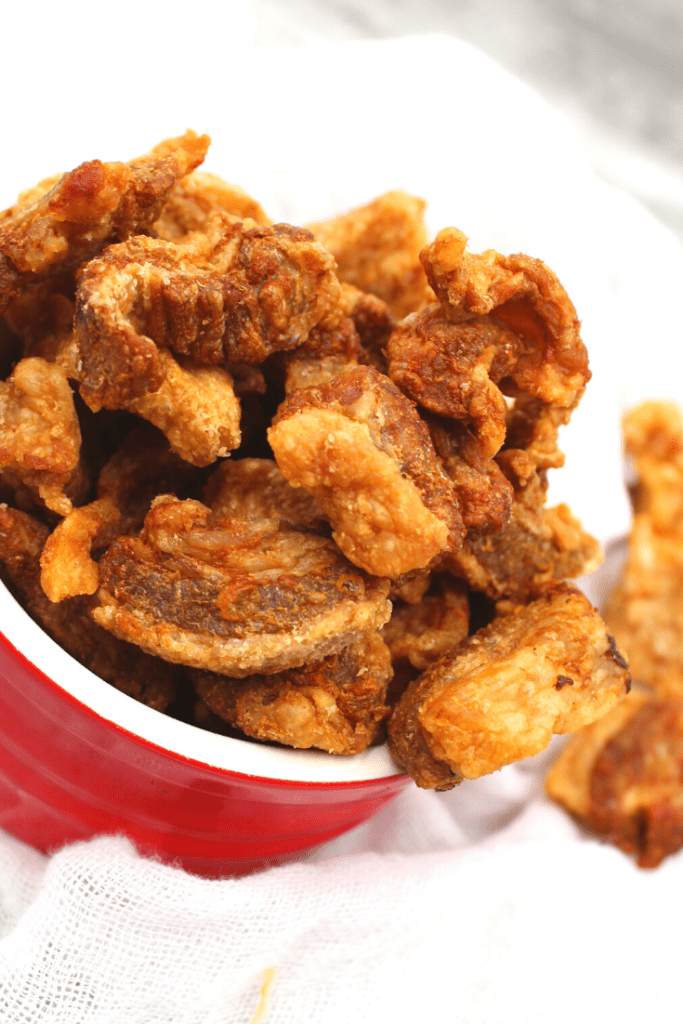
What ingredients do I need to make Air Fryer Pork Cracklings?
- approximately 600 g of pork fat cap
- salt, pepper, garlic and smoked paprika
How do you make Air Fryer Pork Cracklings?
- Remove the fat cap from the freezer and let stand 5- 10 minutes. Fat is much easier to cut when it is still almost frozen
- Using kitchen scissors, cut pork fat cap into the desired size. I did 2-inch strips.
- Place pork in the air fryer and set air fryer to 390 degrees.
- Set the timer for 20 minutes, checking at the 10-minute mark and stirring pork.
- Add an additional 5-minute interval until the pork is crunchy on the outside (mine took 27 minutes total)
- Let cool and remove cracklings from the air fryer.
- Pour pork fat into a glass jar and allow to cool before refrigerating.
How long do Air Fryer Pork Cracklings last?
Pork Cracklings will only last 2-3 days as there are no preservatives. You can freeze them and they will last in the freezer for up to a month. Simply pull out the amount of cracklings you want and place them in a toaster oven for 3-5 minutes to help them crips.
How long does the rendered fat last from the Air Fryer Pork Cracklings?
Pork lard will last in the fridge for 6-12 months. You can use the lard just like you would butter. Add it to savoury pie crusts for an extra treat or use it next time you fry up veggies for a hint of added flavour.
Tips for making Pork Cracklings in an Air Fryer
- I use a Ninja Foodi and it works wonderfully. However, some air fryer will release a black smoke when cooking these pork cracklings (my Power XL Air Fryer always emitted smoke with high-fat foods). If you have this issue, make sure to place some water in the bottom of the air fryer. It is not ideal and you may need to fry the pork for a couple of minutes to get them to the right degree of crispness
- Do not add any sugar or onion flakes to the cracklings as it may burn

I don't have an Air Fryer, can I still make Pork Cracklings?
Absolutely! I actually made my first batch of pork cracklings in a slow cooker.
Here's how:
How to make Pork Cracklings in a slow cooker
- Remove the fat cap from the freezer and let stand 5-10 minutes
- Cut fat cap into 1-inch sections
- Place fat cap and water in the slow cooker
and set it on high for 8 hours
- After 8 hours, remove any leftover fat with a slotted spoon and drain lard into a glass jar.
- Place the remaining pieces of fat in a skillet with salt and onion.
- Cook on high for 5-10 minutes or until brown.
 and set it on high for 8 hours
And there you have it! From a piece of meat that you were most likely going to throw away, you now have not only lard but some delicious pork cracklings!
Looking for more Air fryer recipes? Check out the following:
- Moist Air Fryer Turkey Breast
- Air Fryer Corn on the Cob
- Air Fryer Hard Boiled Eggs - Ridiculously Easy to Peel (SCD Intro Phase)
- Air Fryer Baked Potatoes with a Review of Different Air Fryers (Whole30)
- The BEST Air Fryer Homemade French Fries (Whole30)
- Simply Delicious Fried Chicken (Whole30, Gluten-Free, Low Carb, Egg Free, Dairy-Free)


Air Fryer Pork Cracklings and Lard
Easy and delicious! Try this recipe and I can guarantee you will not be disappointed.
- Total Time: 32 minutes
- Yield: 2 cups 1x
Ingredients
Units Scale
- approximately 600 g pork fat cap, cut into 1-2-inch sections
- 1 tsp salt
- 1 tbsp garlic
- 1 tbsp smoked paprika
Instructions
How to make Pork Cracklings in an Air Fryer
- Using kitchen scissors, cut pork fat cap into the desired size. I did 2-inch strips.
- Place pork in the air fryer and set the air fryer to 390 degrees.
- Set time for 20 minutes, checking at the 10-minute mark and stirring pork.
- Add additional 5-minute intervals until the pork is crunchy on the outside (mine took 27 minutes total)
- Let cool and remove cracklings from the air fryer.
- Pour pork fat into a glass jar and allow it to cool before refrigerating.
How to make Pork Cracklings in a slow cooker
- Remove the fat cap from the freezer and let stand 5-10 minutes
- Cut fat cap into 1-inch sections
- Place fat cap and water in the slow cooker
- After 8 hours, remove any leftover fat with a slotted spoon and drain the lard into a glass jar. Place remaining pieces of fat in a skillet with salt and onion. Cook on high for 5-10 minutes or until brown.
Notes
- if the mixture looks to watery, feel free to remove the lid from the slow cooker
- feel free to add any additional spices to the pork cracklings.
- Prep Time: 5 minutes
- Cook Time: 27 minutes
- Category: Snacks
- Method: Air Fryer
- Cuisine: Whole30, Keto, Gluten Free, Dairy Free
Nutrition
- Serving Size: 1 oz
- Calories: 144
- Sugar: 0
- Fat: 11.9 g
- Carbohydrates: 0
- Fiber: 0
- Protein: 9.6 g
Cat says
I don't know if pork belly would work but I am curious so I will try it in the near future myself! If you try pork belly, let me know how it turns out!!!
Eva says
Hi, can I use pork belly instead?
Thank you